


Your VoIP platform is mission-critical infrastructure, and security issues can quickly lead to financial losses. Toll fraud on Asterisk is a real risk for businesses of all sizes. Unauthorized calls can continue unnoticed until unexpected charges appear on the phone bill.
That’s why Asterisk security best practices should be a core part of custom asterisk development services and ongoing platform management.
This guide covers practical ways to protect your Asterisk platform, including securing SIP registration, configuring firewalls, monitoring call activity, and preventing unauthorized access. It also explains when working with experienced Asterisk developers can help strengthen security and protect your platform.
According to the Communications Fraud Control Association (CFCA) 2023 Global Fraud Loss Survey, telecommunications fraud increased by 12% in 2023, with estimated global losses of $38.95 billion, equal to approximately 2.5% of total telecom revenues.
Why Asterisk Security Cannot Be an Afterthought
Asterisk is open-source, which makes it flexible and widely used, but it also requires careful security configuration. Many toll fraud incidents don’t rely on advanced attacks. Instead, they take advantage of weak passwords, exposed SIP services, and insecure configurations.
The impact of toll fraud can go beyond unexpected phone charges. Businesses may also face service disruptions, compliance concerns, and potential liability from unauthorized use of their VoIP infrastructure. For VoIP providers and ITSPs managing multi-tenant platforms, these risks can affect multiple customers at once.
The good news is that effective Asterisk VoIP fraud prevention doesn’t always require expensive tools. Strong configurations, regular monitoring, access controls, and a team familiar with VoIP security can significantly reduce the risk. These practices help turn a vulnerable Asterisk deployment into a more secure and reliable platform.
The Most Common Toll Fraud Attack Vectors on Asterisk Platforms

Before securing an Asterisk platform, it’s important to understand the most common ways attackers gain access:
- SIP Registration Brute Force: Attackers scan exposed SIP ports and try large numbers of username and password combinations. Weak credentials and predictable usernames make accounts easier to compromise.
- Unauthorized Outbound Calls: After obtaining SIP credentials, attackers can use the account to make expensive international or premium-rate calls, creating unexpected charges.
- Dialplan Exploits: Poorly configured dialplans can allow callers to bypass restrictions and access outbound routes they shouldn’t have access to.
- AMI Interface Exposure: An exposed or weakly protected Asterisk Manager Interface (AMI) can give attackers access to important system controls.
- Unencrypted SIP Traffic: SIP traffic without TLS can expose credentials and session information to attackers who can monitor the network.
Understanding these attack vectors is the first step toward implementing effective Asterisk security best practices and Asterisk VoIP fraud prevention.
Asterisk Security Best Practices: Core Configurations
Secure Asterisk Server: Start with the Basics
The first step to secure Asterisk server deployments is to reduce unnecessary components and protect the core configuration. A minimal, hardened installation has fewer potential attack surfaces.
- Remove unused modules: Disable modules that your deployment doesn’t need. Fewer active modules mean fewer potential attack surfaces.
- Change default credentials immediately: Replace default SIP usernames and weak passwords with strong, unique credentials of at least 16 characters.
- Restrict the AMI: Bind the Asterisk Manager Interface to localhost when possible. If remote access is required, use a secure tunnel such as SSH and limit AMI permissions to only what each application needs.
- Run Asterisk as a non-root user: Use a dedicated system user for the Asterisk process. This limits the potential impact if the service is compromised.
- Keep Asterisk updated: Apply security updates and use a supported Asterisk version. Outdated versions may contain known vulnerabilities that attackers can exploit.
These basic Asterisk security best practices provide a strong foundation for reducing unauthorized access and improving overall platform security.
People Also Read: Asterisk 23: New Features & What They Mean for VoIP Platforms
SIP Security Asterisk: Locking Down Your SIP Stack
SIP handles call signaling on your VoIP platform, so strong SIP security Asterisk configuration is essential for preventing unauthorized access and toll fraud.
- Enable TLS for SIP signaling: Use TLS instead of plain UDP to encrypt SIP messages, including authentication and call-routing information.
- Use SRTP for media encryption: TLS protects SIP signaling, while SRTP protects the actual voice media. Using both provides stronger call security.
- Enable IP whitelisting: Allow SIP registration only from trusted IP ranges when possible. For remote users, combine IP restrictions with strong authentication.
- Set registration expiry limits: Use appropriate registration intervals so devices regularly re-authenticate, reducing the risk of compromised credentials being misused.
- Use strong SIP realm configuration: Configure a non-default SIP realm to make automated scanning and credential attacks more difficult.
- Implement Fail2Ban: Fail2Ban can monitor Asterisk logs and automatically block IP addresses with repeated authentication failures. It’s a simple and effective Asterisk VoIP fraud prevention measure.
Asterisk Firewall Configuration: Your First Line of Defense
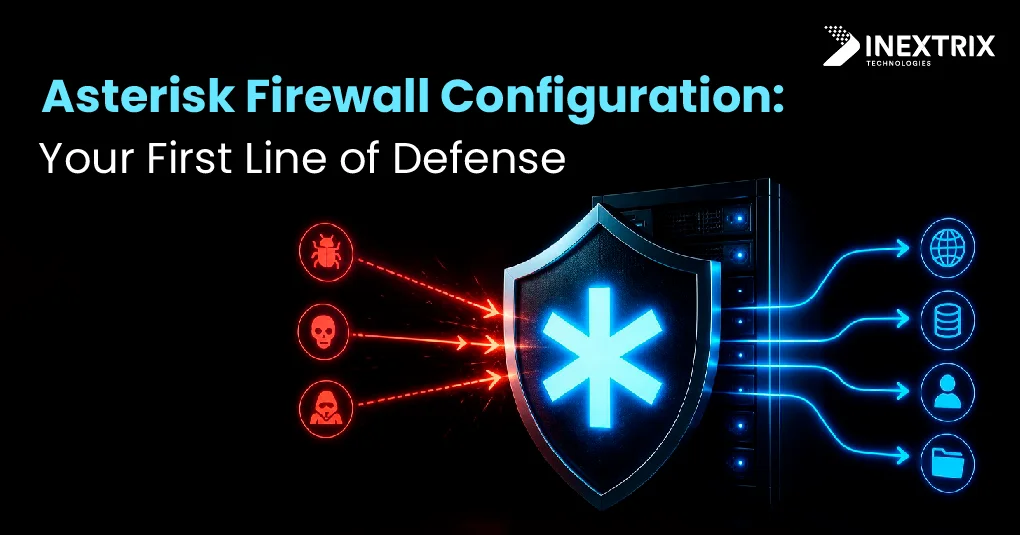
A strong Asterisk firewall configuration is an important part of protecting your VoIP infrastructure. The firewall controls what traffic can reach your Asterisk server and helps reduce unnecessary exposure.
- Block unnecessary SIP ports: Don’t expose SIP services to the public internet unless required. Where possible, combine access controls with IP allowlists.
- Rate-limit SIP REGISTER and INVITE requests: Use firewall tools such as iptables or nftables to limit repeated requests and help reduce brute-force traffic.
- Restrict RTP port ranges: Define a specific RTP port range in rtp.conf and allow only the required ports through the firewall. Avoid unnecessarily large UDP ranges.
- Use a dedicated SIP-aware firewall or SBC: A Session Border Controller (SBC) can provide SIP normalization, topology hiding, access control, and rate limiting specifically for VoIP traffic.
- Implement network segmentation: Keep your Asterisk server on a dedicated network segment where possible. This can limit the impact if another part of the network is compromised.
A properly configured Asterisk firewall configuration works together with SIP authentication, encryption, monitoring, and other Asterisk security best practices to reduce the overall attack surface.
How to Prevent Toll Fraud on Asterisk: Advanced Strategies
Basic security settings protect the obvious entry points. To prevent toll fraud on Asterisk, you also need controls within your dialplan, routing, and billing logic.
- Lock dialplan contexts tightly: Assign each SIP account to the most restricted context it needs. Don’t give unverified users access to international routes.
- Block high-risk destination prefixes: Maintain a list of high-risk destinations and block them at the dialplan level when they aren’t required.
- Implement call spend limits: Set daily or monthly spending limits for each account. Block additional calls when an account reaches its limit.
- Use time-of-day routing controls: Restrict international or high-cost calls during periods when they aren’t normally needed, such as nights or weekends.
- Monitor concurrent call counts per account: Set reasonable concurrency limits and alert when an account suddenly generates an unusually high number of simultaneous calls.
- Disable international calling unless required: If a customer only needs domestic calling, remove international routes from their dialplan entirely.
These controls add multiple layers of Asterisk VoIP fraud prevention, making it harder for compromised accounts to generate large amounts of unauthorized traffic.
People Also Read: Impeccable Benefits of Custom Asterisk Development Services
Monitoring and Real-Time Fraud Detection
Security controls help prevent attacks, but monitoring helps detect threats that get through. Real-time visibility is essential for any production VoIP platform.
- Deploy CDR anomaly detection: Monitor Call Detail Records in near real time. Flag unusual activity such as sudden international calling, unusually high call volumes, or large numbers of short calls.
- Monitor SIP authentication failures: Track failed authentication attempts by IP address. A sudden increase can indicate a brute-force attack and should trigger an immediate alert.
- Use Asterisk CEL and AMI for custom monitoring: Channel Event Logging (CEL) and the Asterisk Manager Interface provide access to real-time call events. This data can be used to build dashboards and integrate with monitoring tools such as Grafana.
- Set up automated call blocking triggers: Automatically block or restrict accounts when predefined fraud thresholds are reached. Faster detection and response can significantly limit potential losses.
- Review logs regularly: Check SIP registrations, authentication failures, and unusual dialplan activity. Regular log reviews can help identify patterns that automated monitoring may miss.
Together, these measures provide an additional layer of Asterisk VoIP fraud prevention and help security teams respond to suspicious activity before it becomes a major financial loss.
How Inextrix Asterisk Development Services Help You Build Secure Platforms

Security should be part of a VoIP platform from the beginning. Adding security after deployment can be more difficult and expensive. This is a key part of Inextrix’s approach to Asterisk development services.
With 16+ years of experience working with VoIP providers, ITSPs, and call center operators across 95+ countries, Inextrix focuses on security throughout the development and deployment process.
Our team provides:
- Secure deployment architecture: Design Asterisk infrastructure with network segmentation, SBC integration, and hardened server configurations.
- Dialplan security review: Review dialplan logic for security gaps, routing issues, and missing call controls.
- Firewall and SIP security configuration: Configure firewall rules, Fail2Ban, TLS, SRTP, and other security controls.
- Ongoing security monitoring: Implement CDR-based anomaly detection and real-time alerts to help identify suspicious activity quickly.
- Security audits of existing platforms: Review existing Asterisk deployments, identify potential vulnerabilities, and provide remediation recommendations.
For teams without in-house Asterisk security expertise, experienced Asterisk developers can help build stronger security into the platform from the start. Proactive security and regular monitoring can help reduce the risk and potential cost of toll fraud incidents.
Asterisk Security Best Practices: Quick Reference Checklist
Use this checklist to review your current Asterisk deployment:
- Change all default SIP credentials before going live
- Disable and remove unused Asterisk modules
- Run Asterisk as a dedicated non-root user
- Bind AMI to localhost or disable it if not required
- Enable TLS for SIP signaling
- Enable SRTP for media encryption
- Configure IP whitelisting for SIP registration where possible
- Deploy Fail2Ban with Asterisk log filters
- Configure iptables/nftables rate limits for SIP traffic
- Use restricted dialplan contexts for each SIP peer
- Block high-risk international prefixes when they aren’t required
- Set concurrent call limits and spending caps for each account
- Apply time-of-day restrictions to international calling
- Implement real-time CDR anomaly monitoring
- Review SIP authentication failure logs regularly
- Keep Asterisk and operating system packages updated
Conclusion:
Toll fraud is an active risk for any production VoIP platform. Automated attacks can exploit weak credentials, exposed services, and poor call controls to generate significant unauthorized traffic.
Following Asterisk security best practices across SIP configuration, dialplan security, firewall protection, access controls, and real-time monitoring create a stronger, layered defense.
If you’re building a new platform or reviewing an existing deployment, Inextrix Asterisk development services can help you build security into the architecture from the beginning. With 16+ years of telecom experience, the team can help with platform hardening, security audits, custom development, and ongoing maintenance.