

When developers and CTOs evaluate platforms for VoIP platform development, one question comes up often: Asterisk vs FreeSWITCH. Which one is the right foundation for a scalable build?
Both are open-source VoIP platforms with years of production use and active communities. However, they were built to solve different problems. That difference becomes more important as your platform grows.
According to a report, the global Voice over Internet Protocol (VoIP) market reached $146.82 billion in 2025 and is expected to grow to $170.22 billion in 2026, representing a 15.9% CAGR. The market is projected to reach $306.24 billion by 2030. As more VoIP platforms are built and traffic volumes increase, providers need a foundation that can handle real-world workloads. Choosing the right platform early can help avoid scalability and performance challenges as the system grows.
This guide is for technical decision-makers who need more than a basic feature comparison. It covers architecture, Asterisk vs FreeSWITCH scalability, Asterisk vs FreeSWITCH performance, call center use cases, and when each platform makes engineering sense.
If you need Asterisk development services or FreeSWITCH development services, understanding the differences first can help you define your requirements more clearly.
What Is Asterisk?
Asterisk is an open source communications framework developed by Mark Spencer at Digium in 1999. It runs on Linux and is widely used for PBX systems, IVRs, and voice applications.
Its core strengths include:
- Extensive documentation and a large developer community
- Native support for various telephony hardware and DAHDI interfaces
- Flexible dialplan scripting for call routing
- Wide adoption among SMBs and enterprise PBX deployments
- A lower learning curve for developers new to VoIP
Asterisk handles call control, codec negotiation, and feature processing within a single process. This design works well for the PBX deployments it was built for. It performs reliably at small-to-medium call volumes. However, challenges can arise when you push the system beyond the limits of its architecture.
People Also Read: Top 10 Asterisk Development Companies in 2026
What Is FreeSWITCH?
FreeSWITCH was created by Anthony Minessale in 2006 to address some of Asterisk’s architectural limitations. It was designed as a carrier-grade media server and application platform.
Key design characteristics include:
- Multi-threaded core architecture, with each session running in its own thread
- Modular design that separates the core from optional modules
- Native SIP stack (Sofia-SIP) without a channel driver abstraction layer
- Built-in support for WebRTC, video calling, and conference bridging
- Designed to handle hundreds of simultaneous sessions with stability
FreeSWITCH is used as the foundation for many softswitch platforms, Class 4 and Class 5 systems, and high-volume call center backends. It can have a steeper learning curve, but its architecture is designed for applications that need high call throughput and scalability.
Asterisk vs FreeSWITCH: Core Architecture Differences

The architecture difference between these two platforms is a key factor in the Asterisk vs FreeSWITCH decision.
Asterisk uses a single-threaded model at its core. Each call passes through a channel driver that handles SIP, DAHDI, and other protocols. This abstraction provides flexibility, but it also adds overhead. Under heavy load, the single-threaded model can create bottlenecks. Asterisk developers often use clustering and Kamailio SIP proxy layers to handle this, but these solutions can add more infrastructure and complexity.
FreeSWITCH uses a multi-threaded design, with each session running in its own thread. This helps the core remain stable under heavy loads. Its modular design also lets you add only the features you need. FreeSWITCH uses the Sofia-SIP stack, which is also used in carrier infrastructure and is designed for reliable SIP communication.
For VoIP platform development at scale, this architecture difference can affect how the platform handles traffic:
- Asterisk handles roughly 50 to 100 concurrent calls on standard hardware without significant optimization
- FreeSWITCH can handle 300 to 1,000+ concurrent calls on the same hardware, depending on the codec and configuration
- FreeSWITCH supports horizontal scaling more naturally
- Asterisk may require SIP proxy layers to distribute traffic across multiple instances
1. Asterisk vs FreeSWITCH Scalability
Scalability is one of the biggest differences between the two platforms. It becomes especially important when building a production VoIP system.
2. Asterisk Scalability
Asterisk scales vertically better than horizontally. You can add more CPU and RAM to increase capacity. However, distributing traffic across multiple Asterisk nodes usually requires external SIP proxies, shared databases, and custom synchronization.
Common approaches for scaling Asterisk include:
- Placing OpenSIPS or Kamailio in front as a SIP proxy dispatcher
- Using ARI (Asterisk REST Interface) for application-level load distribution
- Running multiple Asterisk instances behind a load balancer with sticky sessions
These approaches can work, but they add more infrastructure and potential failure points. They also require additional engineering effort to manage and maintain.
3. FreeSWITCH Scalability
FreeSWITCH supports both vertical and horizontal scaling. Its event socket architecture makes it easier to integrate with external orchestration systems. Its multi-threaded core also uses available CPU resources efficiently.
Scaling FreeSWITCH typically involves:
- Event Socket Layer (ESL) for external call control and event processing
- Deploying multiple FreeSWITCH nodes behind a load balancer
- Using mod_distributor or mod_sofia for intelligent call distribution
- Integrating with databases for state sharing across nodes
This can result in a simpler scaling architecture. For an open-source VoIP platform handling more than a few hundred concurrent sessions, the scaling approach should be evaluated based on traffic, codecs, hardware, and system design.
4. Asterisk vs FreeSWITCH Performance
Performance depends on how each platform handles media processing, codec transcoding, and SIP signaling under load.
5. Media Processing
FreeSWITCH processes media in separate threads from signaling. This separation helps keep SIP processing stable when codec transcoding demand increases. In Asterisk, media and signaling are more closely tied to its core processing model, so heavy transcoding workloads can affect call quality and overall performance.
6. SIP Signaling
FreeSWITCH uses Sofia-SIP, a production-grade SIP stack. Asterisk uses chan_pjsip as its current SIP stack, while chan_sip is now deprecated. chan_pjsip is a major improvement over its predecessor but calls still pass through Asterisk’s channel abstraction layer. At high SIP transaction volumes, this processing model can affect signaling throughput.
7. Latency Under Load
Both platforms can introduce latency under heavy loads. FreeSWITCH’s threading model helps maintain more consistent performance as concurrent sessions increase. With Asterisk, latency can become less predictable at high session volumes as threads compete for CPU resources.
Asterisk vs FreeSWITCH Performance at a Glance

| Factor | Asterisk | FreeSWITCH |
| Concurrent calls (standard hardware) | 50-100 | 300-1,000+ |
| Media processing model | Single-threaded | Multi-threaded |
| SIP stack | chan_pjsip | Sofia-SIP |
| Latency under load | Higher / variable | Lower / consistent |
| WebRTC support | Limited | Native |
| Transcoding scalability | Moderate | Strong |
FreeSWITCH vs Asterisk for Call Centers
The FreeSWITCH vs Asterisk for call centers question is important for call center software builders and hosted contact center providers.
Asterisk has a long history in call centers. VICIdial, one of the widely used open-source predictive dialers, runs on Asterisk. This ecosystem can be useful if you need a proven call center platform with existing features. With specialized Asterisk development services, you can customize the platform without building everything from scratch.
FreeSWITCH is well suited for custom call center builds that need:
- High concurrent agent capacity without overprovisioning hardware
- WebRTC-based browser agent interfaces without additional client software
- Real-time event streaming for analytics, supervision, and AI integrations
- Multi-tenant call center architecture with clear session isolation for each customer
The right option depends on what you are building. If you are extending VICIdial or another Asterisk-based platform, staying with Asterisk and using Asterisk development services can make customization easier. If you are building a call center platform from the ground up, FreeSWITCH provides a scalable foundation, and FreeSWITCH development services can help speed up the development process.
VoIP Platform Development: When to Choose Asterisk

Asterisk can be a good fit for VoIP platform development in these scenarios:
- PBX and hosted PBX systems where Asterisk’s dialplan logic can reduce development time
- Small to medium call volumes where concurrent sessions stay below 150 without major traffic spikes
- Existing Asterisk codebases where the cost of migrating to FreeSWITCH is not justified
- Hardware telephony integrations where Asterisk’s DAHDI support is required
- Proof of concept builds where faster development is more important than maximum performance
- VICIdial-based predictive dialer deployments where Asterisk is the required foundation
People Also Read: Why Businesses Choose FreeSWITCH Development Services for Scalable VoIP Solutions
VoIP Platform Development: When to Choose FreeSWITCH
FreeSWITCH is a strong foundation for VoIP platform development when:
- Carrier-grade platforms need to handle thousands of concurrent sessions
- Class 4 or Class 5 softswitch builds require stable SIP signaling under heavy loads
- Multi-tenant platforms serve multiple customers on shared infrastructure
- WebRTC integration is part of the core product architecture
- Video conferencing or video calling is a required platform feature
- Real-time analytics and event streaming need close integration with call processing
- Horizontal scaling is a requirement from the beginning
Asterisk Development Services vs FreeSWITCH Development Services
Choosing the right platform is only one part of the decision. The other is making sure it is built and configured correctly.
What Asterisk Development Services Cover
Asterisk development services typically include:
- Custom dialplan development and routing optimization
- AGI, AMI, and ARI-based application integration
- VICIdial customization and feature extension
- Asterisk cluster setup and SIP proxy integration
- Codec optimization and call quality tuning
- Migration from legacy PBX systems to Asterisk
What FreeSWITCH Development Services Cover
FreeSWITCH development services typically include:
- Custom module development in C or Lua
- Event Socket Layer (ESL) application development
- Softswitch and Class 4 or Class 5 platform builds
- WebRTC integration and media server configuration
- Multi-tenant platform architecture and design
- FreeSWITCH clustering and high-availability setup
The skill sets for both platforms overlap, but they are not the same. Asterisk dialplan experience does not automatically translate to FreeSWITCH module development. When choosing a vendor for either service, check their production experience with the specific platform and use case you need.
How Inextrix Approaches the Asterisk vs FreeSWITCH Decision
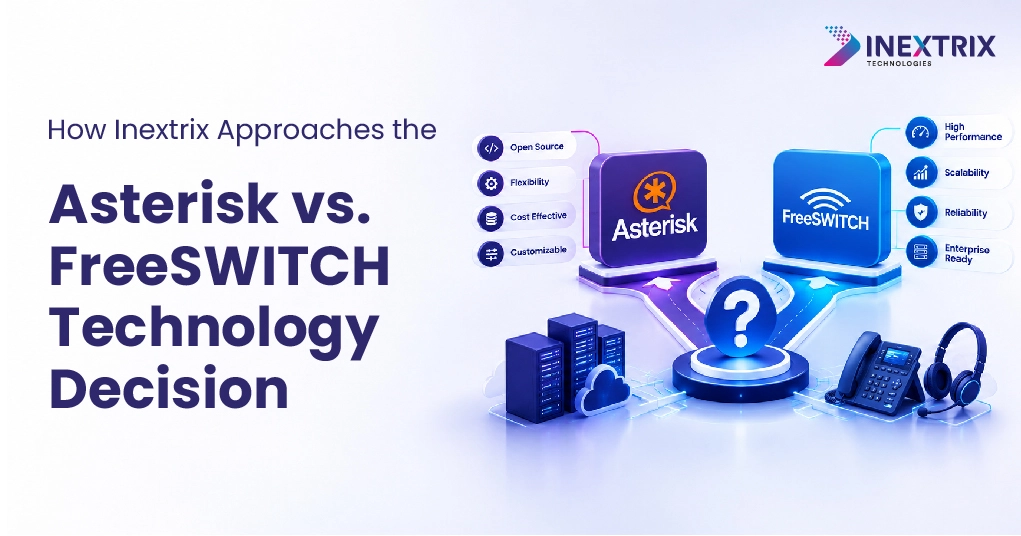
At Inextrix, we have 16+ years of production experience with both Asterisk and FreeSWITCH across 2,500+ projects. This experience helps us understand where each platform works well and where it can have limitations.
We do not recommend one platform by default. The right choice depends on:
- Current and expected call volumes
- Whether the project is a greenfield build or an extension of existing infrastructure
- WebRTC, video, or multi-tenant requirements
- Infrastructure and ongoing engineering budget
- Your team’s familiarity with each platform’s tools and ecosystem
Our Asterisk development services and FreeSWITCH development services include an architecture review before development begins. We review your requirements, match them with the platform’s capabilities, and identify potential gaps before they become production issues.
Conclusion
The Asterisk vs FreeSWITCH decision depends on what you are building and the requirements of your platform. Asterisk has a strong history with PBX systems, VICIdial deployments, and telephony integrations. FreeSWITCH is designed for carrier-grade systems, high-volume platforms, and deployments that need horizontal scaling.
Asterisk development services can be a good fit when you are working within the Asterisk ecosystem or need to build on an established platform. FreeSWITCH development services can be a good fit when your platform needs to handle high concurrent loads or is designed to scale from the beginning.
If you are deciding between the two platforms, Inextrix can help. Talk to our engineering team for a platform recommendation based on your specific requirements.