

The global VoIP services market sits at $201.97 billion in 2026, growing at a 12.9% CAGR. And yet, for every ITSP and enterprise that scales successfully, there are several that pour months of engineering time into a platform that cracks under real traffic. The problem is rarely bad intentions or lazy engineers. It is VoIP software development decisions made before a single call was ever routed.
Most platforms fail not because the technology is wrong but because the architecture was never designed for what the platform eventually became. The session border controller is under-specified. The Class 5 Softswitch is handling jobs it was never built for. The application layer has no API versioning. These are not bugs you patch. They are structural choices that compound silently every year as subscriber count and concurrent traffic grow.
This article breaks down the most common reasons enterprise VoIP projects fail in 2026, and what the correct decisions look like at each layer from SBC architecture through to the application tier.
What Enterprise VoIP Solutions Actually Require in 2026

Enterprise VoIP solutions in 2026 does not simply mean “hosted PBX with more seats” they are distributed telecom platforms with strict requirements on concurrency, compliance, and integration depth. Treating enterprise VoIP as a scaled-up SMB stack is the root cause behind most failed ITSP expansions, because the all-in-one model collapses under multi-tenant, multi-carrier loads.
Talk to any VoIP engineer who has been through a failed platform launch and the story follows a familiar shape. The demo worked. The 500-user pilot worked. Then the platform hit 5,000 concurrent calls and everything started collapsing, post-dial delays, registration storms, billing lag, call drops.
The failure usually traces back to one of three structural mistakes:
- Treating enterprise VoIP as scaled-up SMB VoIP
- Collapsing multiple architectural layers into a single system
- Skipping security and routing hardening at the edge until it becomes urgent
Enterprise VoIP vs. SMB VoIP: The Architectural Gap
SMB VoIP typically runs as a unified all-in-one platform: single tenant, relatively low concurrent call density, and a feature-led roadmap focused on user experience rather than carrier-scale resilience. It works well for a few hundred extensions but is built under the assumption that signalling, media, features, and sometimes even billing are all within one code base.
Enterprise VoIP, on the other hand, separates signalling and media layers, runs multi-tenant by design, and is engineered for carrier-grade concurrency while meeting regulatory requirements like STIR/SHAKEN, E911, and GDPR.
The most expensive mistake an ITSP can make is deploying a feature-rich SMB platform and expecting it to route 10,000 concurrent calls. Works at 500 users. Fails at 50,000. That gap is not a configuration problem. It is an architecture problem.
The Three-layer Enterprise VoIP Architecture Framework
A robust enterprise design starts with:
- Layer 1: Edge Security & Routing: The Session Border Controller (SBC) that manages carrier interconnects, security enforcement, NAT traversal, and SBC routing decisions at the network edge.
- Layer 2: Core Processing: It contains the Softswitch tier: Class 4 for high-speed inter-carrier routing, and Class 5 Softswitch for subscriber features and stateful call logic.
- Layer 3: The Application Layer: It is where VoIP software development lives: billing engines, customer and reseller portals, APIs, WebRTC clients, and analytics systems that turn core telephony into business value. The critical rule is that each layer must be independently scalable; once you collapse layers into one system, you bake in structural bottlenecks that become impossible to fix without a full re-architecture.
Session Border Controller: The Security and Routing Layer Every Enterprise VoIP Platform Needs
The session border controller is the single most under-engineered component in failed VoIP deployments. Operators often treat it as a checkbox something to satisfy a security audit rather than the critical edge device that governs every call entering and leaving the network.
What is a Session Border Controller and What Does It Do?
A Session Border Controller, or SBC, is a specialized piece of equipment designed to secure and control the IP traffic flows. Session border controllers are positioned along the network boundaries for the purpose of controlling IP communications sessions. Initially intended to secure and control VoIP networks, session border controllers now regulate all kinds of real-time communication such as VoIP, IP video, and chat/collaboration sessions.
A properly configured session border controller handles five core functions that most under-designed deployments skip or partially implement:
- Security enforcement: SIP flood protection, toll fraud prevention, IP allowlisting, topology hiding
- NAT traversal: Resolving the private/public IP boundary so media streams reach the right endpoint
- SIP normalisation: Fixing codec mismatches and SIP dialect differences between carriers
- Media transcoding: Converting between G.711, G.729, and Opus at the network boundary
- Call Admission Control (CAC): Rate limiting, bandwidth policies, maximum sessions per trunk
SBC Architecture: Signalling Plane, Media Plane, and B2BUA Design
In a well-designed SBC architecture, the signalling plane manages SIP messages such as INVITE, 200 OK, and BYE, acting as the call control layer, while the media plane handles the RTP/SRTP streams that carry actual voice and video. A B2BUA (Back-to-Back User Agent) architecture terminates every inbound call leg and creates a separate outbound leg, giving the SBC full control over both signalling and media paths.
Here is where SBC architecture decisions go wrong in practice:
- Deploying a stateless proxy instead of a B2BUA: A stateless proxy gives you SIP routing but no control over the media plane; a B2BUA (Back-to-Back User Agent) terminates every inbound call and re-originates a new outbound leg, giving full policy enforcement on both signalling and media
- Single-node SBC with no HA: One node failure takes down every active call; active-active SBC pairs with synchronised session state are the production standard
- No STIR/SHAKEN implementation: Now a regulatory requirement for US enterprise VoIP deployments, not an optional upgrade
- Missing topology hiding: If the SBC is not rewriting Via and Record-Route headers, your internal network structure is visible to every carrier you interconnect with
SBC Routing: How Call Routing Decisions Are Made at the Network Border
At the edge, SBC routing logic starts with dial plan routing, mapping inbound DDI ranges from carriers toward internal Class 4 or Class 5 Softswitches, PBXs, or application servers. For outbound traffic, SBCs often implement Least Cost Routing (LCR), selecting between multiple carriers based on real-time per-prefix cost and reliability metrics stored in a routing table.
Quality-based routing augments LCR by monitoring RTCP and RTP metrics like MOS score, jitter, and packet loss per carrier and automatically failing over when thresholds are breached. Advanced deployments also normalise SIP headers during routing in terms of rewriting P-Asserted-Identity, reordering codecs, and adjusting SDP offers and answers to fit each carrier profile.
In markets like the US, STIR/SHAKEN implementation increasingly sits at the SBC layer, which signs outbound calls with appropriate attestation levels and validates inbound identity to reduce spoofing.
SBC Security Configuration: What To Implement Before Go-live
Prior to go-live, it is essential to secure every enterprise SBC with a baseline security configuration.
- IP allowlisting configured for all carrier SIP trunks
- SIP flood protection: rate limiting per source IP (no more than 50 INVITE/sec from unknown sources)
- SRTP enforced on all external-facing sessions
- Mutual TLS for SIP signalling on carrier interconnects
- Fraud detection rules: international routing anomalies, off-hours call spikes, destination blacklists
- CAC limits set per trunk and per customer
Custom SBC Development Vs. Commercial Deployment: Inextrix’s Approach
Commercial SBCs from vendors like Ribbon and AudioCodes remain a good fit where routing logic is relatively standard, and the main priority is quick, certified interconnect with many carriers. However, they come with recurring licensing costs and limited flexibility when you need custom routing, bespoke security, or deep integration into proprietary billing stacks.
Open-source stacks such as FreeSWITCH (as a B2BUA) and Kamailio (as a high-performance SIP proxy) provide the building blocks for customised SBC deployments tuned to specific ITSP requirements. Inextrix leverages these platforms to deliver custom SBC designs that support advanced LCR, complex quality-based routing, and unique security policies, all without being locked into commercial vendor contracts.
Class 5 Softswitch: The Subscriber Feature Engine
The Class 5 Softswitch is the subscriber feature engine, which means the component that knows every subscriber’s configuration, billing balance, ring groups, and voicemail rules. It is state-heavy by design. That is its job.
The failure happens when operators use the class 5 softswitch to handle high-volume inter-carrier routing work that belongs to a Class 4. A Class 4 is state-light and route-heavy: its only function is routing calls between carriers at high calls-per-second using least-cost routing. It maintains no subscriber state at all.
Using a Class 5 for inter-carrier routing works at 500 concurrent calls. At 5,000, every routing decision triggers a database read, and the system starts queuing. At 10,000, it collapses.
Class 5 Softswitch vs. Class 4: The Architectural Difference That Operators Get Wrong
In VoIP networks, confusing Class 4 and Class 5 Softswitches leads to costly failures. Operators often misuse feature-rich Class 5 platforms for high-volume carrier routing, ignoring core architectural divides.
Class 4 Softswitches are state-light and route-heavy. Their sole job? Blitz calls between carriers at blistering speeds, thousands of calls per second (CPS). They maintain zero subscriber state, relying on lightweight signaling for pure transit efficiency. Ideal for wholesale peering and interconnects.
Class 5 Softswitches, by contrast, are state-heavy and feature-rich. They track every subscriber detail: Do Not Disturb (DND) settings, voicemail, ring groups, even billing balances. Every call leg triggers database queries for authentication, features, and policy enforcement—powerful for retail endpoints, but resource-intensive.
The fatal mistake? Deploying Class 5 for inter-carrier routing. It handles 500 concurrent calls fine but collapses at 5,000. Why? Each routing decision demands a database read, spiking latency and CPU.
Therefore, it is important to choose the right option. Select Class 4 for scale and Class 5 for subscribers or watch your network choke.
Class 5 Softswitch Architecture: The Components That Make It Work
A production-grade Class 5 Softswitch built on FreeSWITCH separates its components so each can be scaled independently:
- SIP Registrar: handles endpoint registration and location services.
- Feature Application Server: dial plan engine, call forwarding, IVR, ring group management.
- CDR Collector: async real-time call detail record generation, forwarded to the billing engine via queue.
- Billing Engine: real-time prepaid balance deduction, postpaid invoice generation, reseller tier billing.
- Multi-tenancy layer: per-tenant dial plan, billing rules, and branding isolation.
FreeSWITCH as the Class 5 Softswitch Core: Why It’s The Right Choice In 2026
In 2026’s multi-tenant VoIP landscape, FreeSWITCH stands out as the premier open-source Class 5 Softswitch. Its modular architecture delivers state-heavy features without vendor lock-in, powering retail services at scale.
- At its heart, mod_sofia handles the SIP stack: registrar functions, back-to-back user agent (B2BUA) mode, and flexible SIP profile management. It authenticates subscribers and enforces per-user policies effortlessly.
- mod_xml_curl unlocks true multi-tenancy. Fetch dynamic dialplans from external APIs in real-time, no hard-coded configs. Each tenant gets customized routing from a central API, enabling rapid provisioning for thousands of customers.
- mod_conference provides a built-in bridge, eliminating separate servers for ad-hoc or scheduled calls, seamless integration for contact centers.
- For billing, mod_cdr_pg_csv streams CDRs directly to PostgreSQL, ensuring precise, real-time records.
The game-changer? ESL (Event Socket Layer). External systems subscribe to call events for programmatic control. Billing platforms monitor in real-time, disconnecting calls when balances hit zero, preventing revenue leaks.
FreeSWITCH scales to 5,000+ CPS with Lua scripting and clustering. Cost-effective, battle-tested, and future-proof for AI integrations, it’s the Class 5 core operators need now.
Warning Signs Your Class 5 Is Approaching Failure
These are not theoretical risks. They are the actual signals that appear in monitoring dashboards before a production system degrades:
- Database query latency climbing above 50ms during peak call hours.
- SIP registration timeouts increasing and the registrar cannot keep pace with re registration traffic.
- Post-dial delay growing beyond 3 to 4 seconds, the feature application server is queuing.
- CDR generation lag where the billing engine is falling behind real-time call events.
- CPU saturation above 70% sustained transcoding or conference load is exceeding capacity.
VoIP Software Development: Building the Application Layer That Enterprise Customers Actually Use
Most VoIP software development mistakes at the application layer are not visible until the platform is already under load or until a major reseller integration break because an API changed without versioning.
The three decisions that cannot be retrofitted:
- API versioning from day one. Every endpoint need /v1/, /v2/ in the path from the first release. Reseller integrations break permanently if versioning is retrofitted after launch. This is not a nice-to-have. It is the foundation every CPaaS integration and reseller ecosystem is built on.
- Async CDR processing. Never write CDR records synchronously in the call path. Use a queue Redis or Kafka between the Softswitch event stream and the billing database. Synchronous CDR writes are the most common cause of billing system bottlenecks under high concurrent load. Calls start hanging post-hangup. Billing accuracy drops. Both are extremely difficult to fix in production.
- Event-driven architecture. Call events like answer, hold, transfer, hangup should be published to a message bus and consumed independently by billing, analytics, and fraud systems. A tightly coupled monolith where these systems all write to the same database in the call path will not scale.
What The Application Layer Must Include for Enterprise Deployments
- REST API Gateway: All Softswitch functions exposed as versioned APIs for CPaaS and reseller integrations.
- Subscriber Self-Service Portal: Call history, voicemail management, feature configuration, DID assignment.
- Real-Time Billing Dashboard: Live balance monitoring, invoice generation, payment gateway integration, fraud alerts.
- Analytics and Reporting: ASR, ACD, MOS scores, jitter, packet loss aggregated per tenant and per carrier.
- Fraud Detection Module: Call pattern anomaly detection, velocity rules per subscriber.
- WebRTC Softphone Client: Browser-based calling via SIP-over-WebSocket.
How SBC, Class 5 Softswitch, and VoIP Software Work Together: A Real Architecture Example
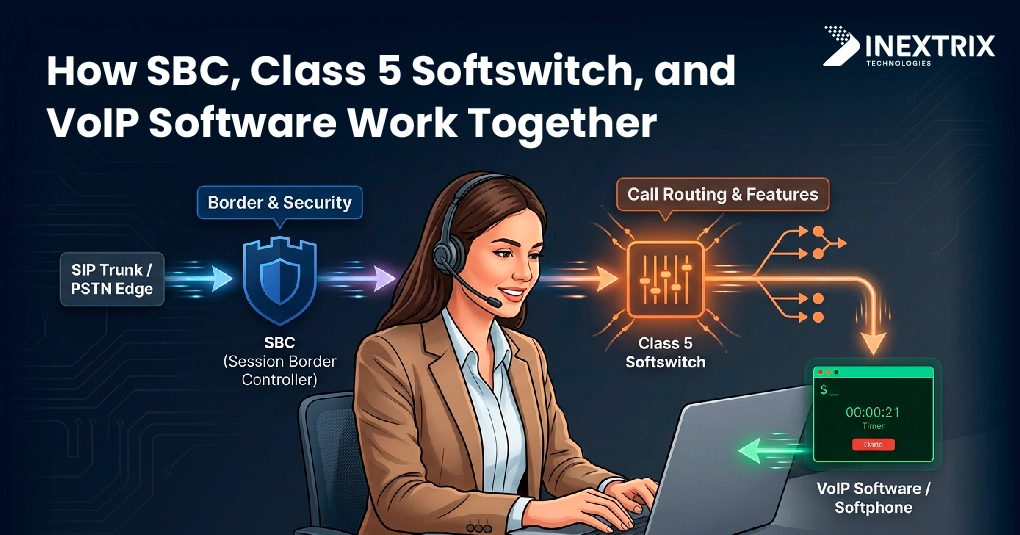
The single most structurally damaging decision in enterprise VoIP platform design is collapsing the three layers: edge routing, core processing, and application into one system. It is tempting because it is faster to build and easier to demo. But each layer has fundamentally different scaling requirements.
- The SBC layer scales horizontally at the edge, adding nodes to handle more concurrent sessions
- The Class 5 Softswitch scales through database optimisation, connection pooling, and CDR queue architecture
- The application layer scales through containerisation Docker and Kubernetes for horizontal API tier scaling
When these layers share infrastructure, you cannot scale one without scaling all three. You cannot upgrade the billing engine without a full platform deployment. You cannot tune the SBC routing configuration without risking the subscriber portal. The coupling turns every maintenance window into a platform-wide risk.
How Inextrix Engineers Enterprise VoIP Solutions End to End

Inextrix builds across all three layers with a methodology that starts with architecture review before any code is written.
What the engagement delivers:
- Layer 1: SBC Engineering: Custom SBC design on FreeSWITCH and Kamailio. LCR and quality-based SBC routing. STIR/SHAKEN implementation. Active-active HA with geographic redundancy.
- Layer 2: Class 5 Softswitch Development: Full custom Class 5 builds with multi-tenant architecture. Integrated billing engine, CDR processing, subscriber and reseller portals. Database optimisation and CDR queue architecture for carrier-grade scale.
- Layer 3: VoIP Software Development: REST API design, WebRTC softphone integration, billing and analytics systems, fraud detection. Every engineer on the project carries platform-level FreeSWITCH or OpenSIPS experience.
Conclusion:
Enterprise VoIP projects in 2026 fail not because the technology is wrong, but because the architecture is still built for SMB workloads: an under‑engineered SBC, an overloaded Class 5 Softswitch handling carrier routing, and a tightly coupled application layer with no API versioning or async CDR processing.
The right path forward is a cleanly separated three‑layer design that includes edge SBC for security and routing, Class 4 for high‑speed carrier transit, and a feature‑rich Class 5 core such as FreeSWITCH backed by a multi‑tenant, event‑driven application layer so that scaling, compliance, and integration can grow in step with the platform instead of becoming a source of chronic instability.