

When a VoIP platform handles hundreds or thousands of simultaneous calls, its underlying architecture becomes increasingly important. FreeSWITCH scalability is not something you achieve by simply changing one setting. It depends on several engineering decisions made during the design stage. If these decisions are overlooked, scaling the platform later can become costly and disruptive.
This blog explains these key decisions, why they matter, and how they affect real-world platform performance. Whether you are building or expanding a VoIP platform or evaluating FreeSWITCH development services, this guide covers the main engineering considerations you need to address before call volumes increase.
According to a report, the global VoIP services market was valued at USD 40.22 billion in 2022 and is projected to grow at a CAGR of 10.2% from 2023 to 2030.
As more providers enter the market and call volumes grow across enterprise and consumer platforms, a scalable architecture becomes essential. Getting the architecture right from the start can help build a VoIP platform that remains reliable as demand increases.
Why FreeSWITCH Concurrent Calls Demand Architectural Thinking
FreeSWITCH handles media processing, SIP signaling, and call state management within the same process. This makes it powerful, but at scale, multiple components can compete for the same system resources.
FreeSWITCH concurrent calls put pressure on several layers:
- CPU: Each active call needs media processing, codec transcoding, and signal handling. As concurrent calls increase, CPU usage also rises unless calls are distributed across multiple nodes.
- Memory: FreeSWITCH keeps call session data in memory. As concurrency grows, this data increases and can put significant pressure on available memory.
- Network I/O: RTP media streams use considerable bandwidth. Poor NIC configuration or limited network capacity can affect call quality as call volume increases.
- Database connections: Routing, authentication, and CDR operations may rely on external database lookups. As call volume grows, these operations can slow down, especially when connection pooling is not configured properly.
The architectural decisions made before deployment play a major role in how well FreeSWITCH handles these pressures. Scaling a single-node, monolithic setup later is possible, but it is usually more costly and disruptive than designing the platform for scalability from the beginning.
Core Architecture Patterns for FreeSWITCH Scalability

1. Single-Node vs. Distributed Architecture
A single FreeSWITCH instance can handle a few hundred concurrent calls under the right conditions, including optimized kernel settings, a properly configured NIC, enough RAM, and minimal transcoding. Beyond this point, performance may decline, or the architecture may need to be redesigned.
A Scalable FreeSWITCH architecture usually follows one of two approaches:
- Horizontal scaling: Multiple FreeSWITCH nodes handle different portions of the concurrent call load. A front-end component distributes traffic across these nodes.
- Vertical scaling: Additional CPU, RAM, or other resources are added to a single node. However, this approach has limits and is not a sustainable long-term strategy for high-volume deployments.
In many production environments, both approaches are used. Vertical scaling supports moderate growth, while horizontal scaling handles demand that goes beyond the capacity of a single node.
2. SIP Proxy as a Front-End Layer
Placing a SIP proxy, such as OpenSIPS or Kamailio, in front of FreeSWITCH is a common architecture for handling high FreeSWITCH concurrent calls. The SIP proxy can manage:
- SIP signaling distribution across multiple FreeSWITCH nodes
- Registration load offloading
- Routing logic and call admission control
- Failover detection and traffic rerouting
This separation is important because SIP proxies are lightweight and can be designed to remain largely stateless, while FreeSWITCH handles the more resource-intensive processing.
Separating signaling and media processing also allows each component to scale independently. This flexibility is an important part of designing for FreeSWITCH scalability.
FreeSWITCH Load Balancing: Getting Traffic Distribution Right
FreeSWITCH load balancing helps prevent any single node from becoming overloaded. Without proper load balancing, too many calls may end up on one server while other servers remain underused.
Load Balancing Approaches
Several load-balancing strategies can be used in production environments:
- Round-robin: Incoming calls are distributed across nodes in sequence. It is simple and predictable, but it does not consider the current load on each node.
- Least connections: Calls are sent to the node with the fewest active sessions. This can work better than round-robin when workloads are uneven.
- Weighted distribution: Each node is assigned a weight based on its capacity. This is useful when servers in the cluster have different hardware specifications.
- Hash-based routing: Calls from the same endpoint or destination are consistently routed to the same node. This can be useful for stateful sessions.
What OpenSIPS Adds to Load Balancing
When OpenSIPS is placed in front of FreeSWITCH, its load_balancer module can monitor the capacity and active load of FreeSWITCH nodes. When a node reaches its configured threshold, new calls can be routed to another available node.
Combined with heartbeat checks, this approach helps keep FreeSWITCH load balancing accurate and reduces the risk of sending new calls to an overloaded or unavailable node.
People Also Read: Why OpenSIPs Is the Smart Choice for Scalable SIP Routing?
FreeSWITCH Clustering for Distributed Call Handling
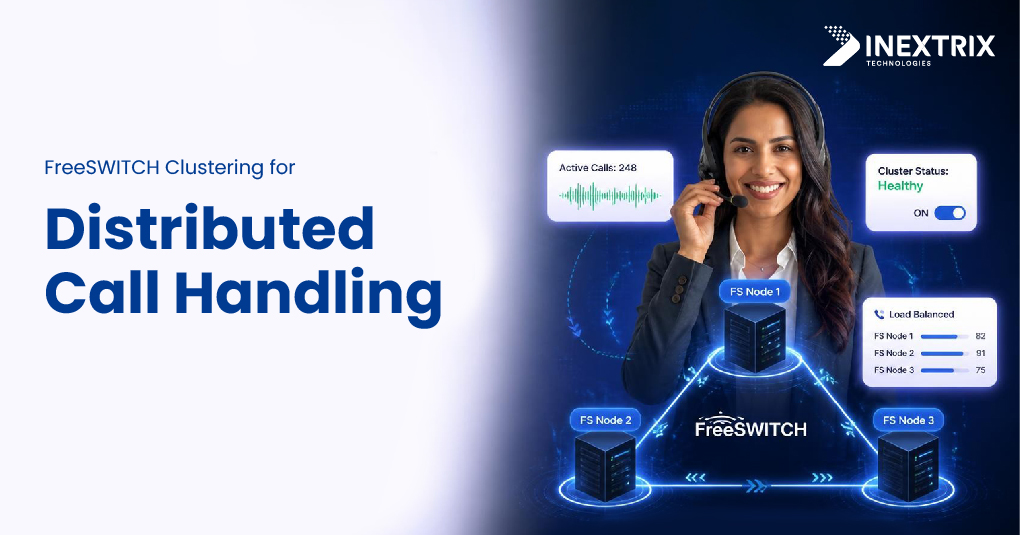
FreeSWITCH clustering takes load balancing a step further by adding shared state and coordinated failover. While load balancing distributes traffic across servers, clustering helps multiple nodes work together as one system.
What Clustering Actually Requires
A FreeSWITCH cluster is more than just running multiple nodes behind a proxy. It requires:
- Shared or synchronized registration databases: Users registered on Node A should be able to receive calls routed through Node B.
- Session border data coordination: Active calls may need shared state on another node to make the right routing decisions.
- Consistent routing tables: All nodes should use the same dial plan or connect to a centralized routing engine.
- Cluster-aware media handling: Media servers or RTP proxies should manage streams that start on one node and end on another.
Tools That Support FreeSWITCH Clustering
- ESL (Event Socket Layer): Allows external applications to monitor and control FreeSWITCH instances across the cluster for coordinated call management.
- Redis or Memcached: Stores shared session and registration data across nodes.
- Consul or Zookeeper: Supports service discovery and monitors node health within the cluster.
- rtpproxy or rtpengine: Routes media streams through a centralized proxy to support node-to-node RTP traversal.
FreeSWITCH High Availability: What It Actually Takes
FreeSWITCH high availability means keeping the system running even when something fails, such as hardware, a network connection, or a software crash. High availability is different from load balancing. A system can use load balancing and still have a single point of failure.
Common Failure Points in FreeSWITCH Deployments
- Single FreeSWITCH node: If the node crashes, all active calls on it are dropped.
- Single SIP proxy: If OpenSIPS or Kamailio goes down, new calls cannot connect even when the FreeSWITCH nodes are working.
- Single database: Call routing, registration lookups, and CDRs may depend on the database. If it fails, the platform may stop routing calls correctly.
- Single RTP proxy: If the RTP proxy fails, media can be disrupted for all active calls using it.
Building Genuine High Availability
Real FreeSWITCH high availability requires redundancy across each layer:
- Active-active or active-passive SIP proxy pairs: Keepalived or Corosync with a shared VIP can help switch traffic to another proxy when one goes down.
- Replicated registration databases: Redis Sentinel, MySQL Group Replication, or similar setups keep registration data available if the primary database fails.
- Multiple RTP proxies: Traffic can be distributed across multiple rtpengine instances, with failover managed at the SIP proxy layer.
- Geographic redundancy: For critical deployments, placing nodes in different data centers can protect against data center-level failures.
Failover speed is also important. An HA setup that takes 60 seconds to switch over may not be suitable for a production VoIP platform, especially when active calls are affected. Well-designed scalable FreeSWITCH architecture deployments often target failover times of around 5 to 10 seconds.
FreeSWITCH Performance Optimization at Scale
Architecture sets the limit. FreeSWITCH performance optimization helps you get the most out of that architecture. Even a well-designed system can perform poorly if the infrastructure is not configured properly.
OS-Level Tuning
- CPU governor: Set it to performance mode to prevent CPU frequency changes from affecting real-time media processing.
- IRQ affinity: Assign network interface interrupts to specific CPU cores to reduce context switching.
- NUMA awareness: On multi-socket servers, keep FreeSWITCH processes on the same NUMA node as their assigned NIC to reduce memory access delays.
- Huge pages: Use huge pages for processes that handle large memory-mapped datasets.
Kernel Networking Parameters
Adjust these sysctl settings for high-throughput VoIP workloads:
- net.core.rmem_max / net.core.wmem_max: Increase receive and send buffer sizes.
- net.ipv4.udp_mem: Adjust UDP memory allocation for heavy RTP traffic.
- net.core.netdev_max_backlog: Increase the packet queue size to handle traffic spikes.
FreeSWITCH Internal Configuration
- Worker threads: Set the thread count based on available CPU cores. Too many threads can cause contention, while too few can leave CPU capacity unused.
- RTP port ranges: Set a wide enough range to support peak concurrent calls and avoid port exhaustion.
- Codec negotiation: Limit codec options to those the system can handle without transcoding whenever possible. Transcoding uses significant CPU resources.
- CDR write handling: Move CDR writes away from the main call-processing thread by using async handlers or a message queue.
Database Optimization for FreeSWITCH
- Use PostgreSQL or MySQL with connection pooling, such as PgBouncer or ProxySQL, to handle high-concurrency lookup requests.
- Index registration, routing, and CDR tables based on the access patterns generated by FreeSWITCH.
- Use in-memory caching for routing data that does not change frequently.
Building a Scalable FreeSWITCH Architecture: Development Decisions That Hold Under Load
When building a scalable FreeSWITCH architecture that can handle a high number of FreeSWITCH concurrent calls, several key decisions can affect performance and reliability.
1. Where the SIP Proxy Lives in the Stack
Placing OpenSIPS or Kamailio at the edge, before FreeSWITCH, is a common approach for high-volume deployments. It handles SIP traffic, manages routing, and reduces the signaling load on FreeSWITCH nodes.
2. How Media Routes Across Nodes
When calls start on one node and end on another, media needs to be routed correctly. RTP proxies help manage cross-node media traffic and are important in multi-node deployments.
3. What the Registration Database Architecture Looks Like
Centralized and replicated registration data is important for multi-node setups. Without it, routing can become unreliable when calls move between nodes.
4. How Failover Is Triggered and How Fast It Happens
Health checks should run often enough to detect failed nodes quickly. Failover should also handle active calls properly, not just new call requests.
5. Where the Scaling Limits Are and How They Are Monitored
Every node has a limit on how many calls it can handle. Monitoring active sessions against configured limits and setting up automatic alerts can help identify capacity issues before they cause outages.
How Inextrix Approaches FreeSWITCH Development Services

Inextrix has over 16 years of experience building and scaling FreeSWITCH-based platforms for VoIP providers, ITSPs, and CPaaS companies. Our FreeSWITCH development services cover the complete architecture lifecycle, including design, implementation, FreeSWITCH performance optimization, and long-term platform support.
Companies that hire FreeSWITCH developers from Inextrix get developers who understand FreeSWITCH at the code level, not just the configuration level. This allows them to optimize internal FreeSWITCH modules, create custom dialplan logic, integrate external systems, and solve performance issues that basic troubleshooting guides may not address.
Our work includes:
- Multi-node FreeSWITCH cluster design and deployment
- OpenSIPS and Kamailio integration for FreeSWITCH load balancing and FreeSWITCH high availability
- FreeSWITCH performance optimization for platforms handling 1,000 or more concurrent calls
- Custom module development for specialized routing, billing, or media handling requirements
- Ongoing platform monitoring and capacity planning for scalable FreeSWITCH architecture
Conclusion:
FreeSWITCH scalability depends on more than the platform itself. It depends on the architecture around it and the decisions made at every layer, including how signaling is handled, how media moves between nodes, where registration data is stored, and how quickly the system responds to failures.
Making these decisions during the design stage is much easier and more cost-effective than fixing problems after the system is under load. If your platform is reaching its current limits or needs to support high FreeSWITCH concurrent calls from the beginning, these architecture decisions provide a strong starting point.
Inextrix FreeSWITCH development services focus on solving these types of engineering challenges. If you are planning to scale your FreeSWITCH platform or want to hire FreeSWITCH developers for complex deployment requirements, our team can help you plan and implement the right approach.