


Asterisk powers millions of VoIP deployments worldwide. It handles moderate traffic well, gives developers a high level of flexibility, and remains a popular choice for telecom projects.
But as call volumes increase, performance issues can start to appear. Call quality may drop, setup times can increase, and the system may struggle to handle new connections reliably.
Asterisk performance optimization is more than changing a few settings. At higher traffic levels, it requires proper engineering to identify and fix underlying performance bottlenecks. This is where professional Custom Asterisk development can make a real difference, not only during development and deployment, but also when keeping the platform stable under real-world traffic.
This article looks at the common performance challenges that appear at scale, what causes them, and the engineering approaches that can help solve them. The focus is on structural issues rather than basic configuration tweaks.
Why Asterisk Degrades at Scale
The architecture of Asterisk was not originally designed for carrier-grade call volumes. It evolved from a single-server PBX into a widely used VoIP engine, and modern versions are far more capable. However, as traffic grows, its threading model and resource usage can still create performance bottlenecks in production environments.
As concurrent calls increase, Asterisk can gradually experience issues such as lower call quality, longer call setup times, higher latency, and increased resource usage. These problems rarely appear all at once.
For most production teams, the challenge is a gradual decline in performance. The system may continue to work, but the user experience slowly gets worse as traffic puts more pressure on the platform.
That makes Asterisk performance optimization important before performance issues become critical. Identifying bottlenecks early and addressing the underlying infrastructure can help keep the platform stable as call volumes grow.
Asterisk High Call Volume Issues: Root Causes

Asterisk high call volume issues usually don’t come from one problem. As traffic increases, several system and architecture issues can start affecting performance at the same time.
- Thread contention: Asterisk uses threads to handle channels, and a high number of concurrent channels can put significant pressure on CPU scheduling.
- SIP channel driver overhead: Older deployments may still use chan_sip, while newer setups typically use chan_pjsip. Both require proper configuration and tuning for high concurrency.
- Memory allocation: Heavy traffic can increase memory allocation and release activity. Poor heap management can lead to fragmentation and affect real-time audio processing.
- Database and AGI bottlenecks: Dialplan lookups, AGI scripts, and real-time database queries can introduce delays that become more noticeable as call volume increases.
- Codec transcoding: Transcoding between codecs can consume significant CPU resources, especially when many calls require it at the same time.
- File descriptor limits: High channel counts can reach operating-system file descriptor limits, resulting in failed registrations or dropped connections.
Most of these challenges are connected. Fixing one bottleneck without looking at the overall architecture may simply move the performance problem somewhere else.
That’s why effective Asterisk performance optimization requires a combination of system tuning, application-level improvements, and infrastructure planning.
Asterisk Scalability Issues in Production Environments
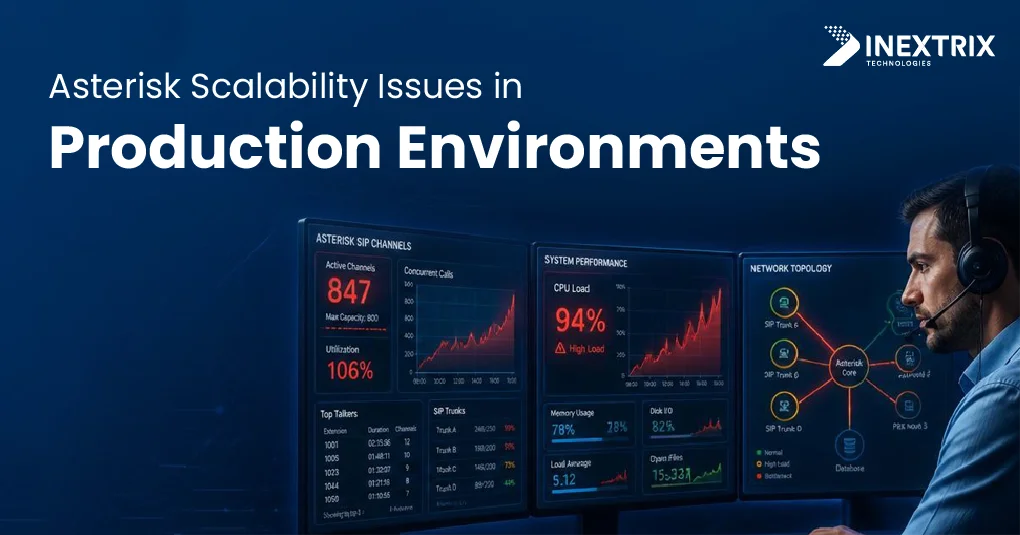
Asterisk scalability issues can look different depending on the deployment. A SIP trunking platform may struggle with high call volumes, a contact center may experience slow AGI responses, and a multi-tenant PBX may start dropping registrations as the number of devices increases.
In most cases, the pattern is similar: performance is stable at moderate traffic levels but gradually gets worse as the load increases. Adding more hardware may provide temporary relief, but if the underlying architecture is the problem, the same bottleneck can appear again.
Common production challenges include:
- Registration storms: Handling thousands of SIP registrations can create processing queues. As endpoints retry their registrations, the additional traffic can put even more pressure on the system.
- Dialplan execution bottlenecks: Complex dialplans, database lookups, and external scripts can slow call setup when traffic increases.
- Memory issues in long-running instances: Continuous operation can lead to memory fragmentation and gradual performance degradation that may not appear during short-term testing.
- Lack of graceful degradation: When resources become limited, Asterisk may start rejecting calls or connections instead of managing the extra load through effective queuing or rate limiting.
These Asterisk scalability issues show why simply adding CPU or memory is not always enough. A scalable deployment needs the right architecture, configuration, and resource management from the start.
People Also Read: How Asterisk Development Helps You Build Feature-Rich VoIP Applications?
Asterisk SIP Performance Bottlenecks Under Load
Asterisk SIP performance needs special attention because SIP processing is often one of the first areas to show stress as call volume increases. Asterisk handles REGISTER, INVITE, BYE, OPTIONS, and re-INVITE traffic at the same time. Under heavy traffic, managing all these requests efficiently can become challenging.
Some common SIP bottlenecks include:
- Transaction timer misconfiguration: Default SIP timers work well in stable network conditions. Network delays can trigger retransmissions, adding unnecessary traffic and processing load.
- OPTIONS flood handling: Carrier trunks often send frequent OPTIONS keepalives. While each request uses limited resources, the overall impact can become significant at high volumes.
- TLS/SRTP overhead: Secure signaling and media require additional CPU resources. Without proper optimization, encryption can put extra pressure on the system.
- TCP vs. UDP handling: SIP over TCP adds connection-management overhead. Large deployments can experience connection issues when TCP connections are not configured and managed efficiently.
Improving Asterisk SIP performance requires more than changing application settings. The SIP configuration, operating system, network stack, and overall infrastructure all need to work together.
For high-volume environments, proper Asterisk performance optimization at both the application and OS networking levels is essential for maintaining stable call processing.
The Real Business Cost of Poor Asterisk VoIP Platform Performance

Poor Asterisk VoIP platform performance is not just a technical issue. It can directly affect customers, revenue, and day-to-day business operations.
The impact can include:
- Failed and dropped calls: Poor call quality leads to more support tickets and can increase customer churn.
- Carrier SLA issues: Service problems can result in SLA breaches, penalties, and strained carrier relationships.
- Higher engineering workload: Teams spend more time fixing performance issues instead of working on new features and improvements.
- Reputation damage: Poor call quality can reduce customer trust, especially among enterprise buyers, and can take time to rebuild.
For contact centers, performance issues can mean choppy audio, failed transfers, and disrupted customer conversations. For ITSPs and VoIP providers, poor performance directly affects the quality of the service customers are paying for.
Asterisk can be a powerful VoIP platform, but high-volume deployments need proper Asterisk performance optimization, tuning, and infrastructure planning rather than relying solely on default settings.
Asterisk Performance Tuning: What Actually Works
Asterisk performance tuning needs to cover two areas: the operating system and the Asterisk application itself. Focusing on only one side usually gives limited results.
System-Level Tuning
- Increase file descriptor limits: Raise ulimit -n to support a higher number of concurrent channels. Apply the limits to both the system and the Asterisk process.
- Set CPU affinity: On multi-core servers, assign CPU resources to Asterisk threads when other applications are competing for processing power.
- Tune kernel network parameters: Adjust socket buffer sizes, TCP backlog, and ip_local_port_range to better handle high SIP connection volumes.
- Prioritize Asterisk processes: Use a real-time kernel or appropriate CPU scheduling priority when low audio latency is critical.
- Optimize memory settings: Configure huge pages and memory allocator settings where appropriate to reduce fragmentation under heavy workloads.
Asterisk Application-Level Tuning
- Move from chan_sip to chan_pjsip: If you’re still using chan_sip, migrating to chan_pjsip can improve how the system handles modern SIP deployments and concurrency.
- Disable unnecessary modules: Remove unused modules, especially media-processing components that consume resources without providing value for your deployment.
- Optimize real-time database queries: Use properly indexed database tables to prevent slow lookups from delaying dialplan execution.
- Simplify dialplans: Reduce unnecessary conditional branches and avoid complex nested subroutines in frequently used call paths.
- Tune threadpool settings: Configure thread pools based on your workload, since inbound-heavy and outbound-heavy environments may require different settings.
- Use AstDB where appropriate: For simple key-value lookups, AstDB can reduce the need for external database calls and network roundtrips.
These steps can address many common Asterisk performance problems. However, tuning alone cannot fix architectural limitations. If a deployment has grown from a single Asterisk instance to carrier-scale traffic, it may require a broader architecture that includes load distribution, clustering, and infrastructure designed for high availability.
When Architecture Changes Are the Only Fix for Asterisk Scalability Issues
At a certain point, Asterisk scalability issues cannot be solved with configuration changes alone. When call volumes continue to grow, the underlying architecture may need to change.
For carrier-level deployments, several architectural approaches can help:
- Horizontal scaling with SIP load balancing: Deploy multiple Asterisk instances behind an OpenSIPS or Kamailio SIP proxy. This distributes calls across servers while the proxy handles routing, registrations, and failover.
- Media anchor offloading: Use RTP proxy solutions such as RTPengine to handle media relay and reduce the media-processing load on Asterisk. This allows Asterisk to focus more on signaling and dialplan execution.
- Database decoupling with caching: Add a caching layer such as Redis or Memcached in front of the database. This reduces repeated database calls and helps lower latency during high traffic.
- Asynchronous AGI processing: Move time-consuming AGI operations to FastAGI servers and use asynchronous processing where possible. This reduces waiting time in call flows and allows Asterisk to continue handling other tasks.
These changes require more than simple configuration tweaks. They involve architecture planning, testing, and engineering based on the actual workload.
For large-scale deployments, treating Asterisk performance optimization as an infrastructure engineering project and not just a settings exercise, is often the key to long-term scalability.
When to Hire Asterisk Developers for Scalability Engineering

The need to hire Asterisk developers often becomes obvious after a platform starts struggling under heavy traffic. But bringing in specialists before that point can help prevent costly performance problems.
Some common signs that it’s time to involve experienced Asterisk specialists include:
- Resource usage increases faster than call volume: Doubling call traffic results in more than double the CPU or memory usage.
- Tuning stops helping: Configuration changes provide smaller improvements, while the same bottlenecks keep coming back.
- Call quality changes with traffic: Audio quality becomes worse during peak hours or high-traffic periods.
- Engineering time is being lost: Your team spends too much time troubleshooting Asterisk instead of developing new features.
- The architecture no longer matches the workload: The platform was designed for a smaller deployment and is now handling much higher traffic.
General VoIP developers can configure and deploy Asterisk, but complex scalability problems often require deeper expertise. Experienced Asterisk developers understand the SIP stack, threading model, memory usage, and OS-level networking needed to identify bottlenecks and build a more scalable platform.
Getting specialist help early can be much easier than trying to fix a production system after it reaches its limits.
How Inextrix Delivers Asterisk Development Services

Asterisk development services from Inextrix focus on helping VoIP platforms handle real-world traffic reliably and scale as business needs grow.
With more than 16 years of experience working with FreeSWITCH, OpenSIPS, Kamailio, and Asterisk, Inextrix has supported 1,200+ clients worldwide across different VoIP and telecom projects.
The services cover key areas of Asterisk performance and scalability:
- Performance audits: Analyze systems under real workloads to identify actual bottlenecks and provide clear, prioritized recommendations.
- Asterisk performance optimization: Tune both the operating system and Asterisk configuration, with before-and-after testing to measure improvements.
- Architecture redesign: Update or rebuild outdated architectures to support higher call volumes and future growth.
- Horizontal scaling implementation: Set up SIP proxy layers, RTP offloading, and database caching to distribute workloads across multiple servers.
- Dedicated Asterisk developers: Provide experienced developers for ongoing development, maintenance, troubleshooting, and optimization.
The goal is simple: build an Asterisk platform that can handle the required call volume reliably today while leaving enough capacity for future growth.
Conclusion
Asterisk VoIP platform performance can become a major challenge for VoIP providers, ITSPs, and contact center software companies as call volumes grow. Asterisk is flexible and powerful, but default configurations and single-instance setups may not be enough for high-volume production environments.
Solving these challenges usually takes more than basic tuning. It requires proper diagnosis, system and application-level optimization, and, when needed, an architecture that can distribute workloads and remove bottlenecks.
Effective Asterisk performance optimization helps maintain stable call quality and reliable performance as traffic grows. Working with experienced Asterisk developers can make this process easier by bringing the right platform and production expertise to the table.
If your Asterisk platform is struggling with performance or scalability, talk to the Inextrix engineering team to explore the right approach for your deployment.