


Running a call center on a platform that cannot scale is not a technical inconvenience. It is a revenue problem.
The global call center market is valued at USD 34.22 billion in 2026 and is projected to reach USD 56.77 billion by 2032, growing at an 8.54% CAGR. Inside that growth is a fast-moving shift toward platforms that can handle real operational complexity: high concurrent call volumes, predictive dialing at scale, custom CRM integrations, and real-time reporting that managers can efficiently act on.
VICIdial is at the core of this demand. With over 14,000 installations worldwide, it is the most widely deployed open-source call center platform in operation. But the gap between a default VICIdial setup and a production-ready, scalable call center solution is not a configuration gap. It is an engineering gap.
This guide covers what VICIdial development involves: the architecture decisions that determine scalability, the customization layers that separate a generic deployment from a competitive product, and the engineering practices that keep it stable under real-world load.
What Is VICIdial and Why It Still Dominates in 2026
VICIdial is an open-source contact center suite built on Asterisk, MySQL, and a PHP-based web interface.
It handles inbound and outbound campaigns, predictive dialing, ACD routing, IVR flows, agent scripting, and reporting. The 2026 revision (v2.14b0.5) supports PHP 8.2, Asterisk 18, and WebRTC through ViciPhone v3.0.
What makes VICIdial worth building on:
- No per-seat licensing. For operations above 75 to 100 agents, VICIdial’s cost structure consistently outperforms commercial alternatives.
- Predictive dialing with real-time adaptive algorithms, not basic power dialing.
- Horizontal scalability through multi-server clustering across Asterisk nodes.
- Source-level access. Every component can be modified, extended, or replaced.
- A large global installation base that proves it works under production load.
The open-source model is an advantage only if you have the capability to exploit it. Most teams do not. That is exactly were VICIdial development services become the deciding factor.
People Also Read : Is FreeSWITCH Better Than Asterisk? Explore the blog Now
The Real Challenges Behind VICIdial Development
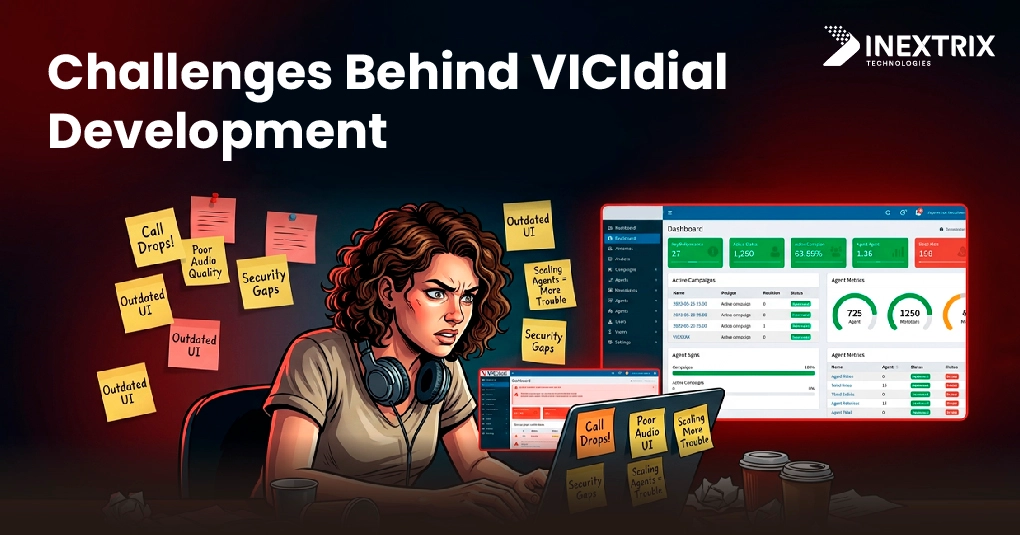
Here is a common set of points at which most new VICIdial deployment projects reach their limits. Understanding these bottlenecks is the first step toward designing a solution that can bypass them and ensure stable, scalable performance.
1. Scalability Under Concurrent Load
A single-server VICIdial instance handles roughly 50 to 100 concurrent calls before RTP processing, MySQL query volume, and campaign management threads start competing for resources. Beyond that, without proper clustering, call quality deteriorates and the system becomes unstable.
2. Database Bottlenecks
VICIdial writes heavily to MySQL. Call logs, agent status updates, campaign lead data, and real-time reporting all hit the same database. Without read replicas, query optimization, and index tuning specifically for call center workloads, this becomes the first failure point at scale.
3. Integration Complexity
Default VICIdial does not connect cleanly to modern CRMs, billing systems, or analytics platforms. Building those integrations on a live system, without breaking campaign execution or agent workflows, requires careful API design and thorough testing against real traffic patterns.
4. Security and Compliance Exposure
VICIdial deployments that run unpatched or with default configurations carry significant security exposure. TCPA compliance, call recording storage, and agent data access controls all require deliberate engineering attention rather than default settings.
Core Architecture for a Scalable Call Center Platform
A scalable VICIdial architecture is not just a larger server, it is a distributed setup designed to handle call center load efficiently.
1. Multi-Server Asterisk Clustering
For high-volume VICIdial deployment, multiple Asterisk servers are used together to support 500+ agents. Each server handles a portion of the call traffic, while VICIdial distributes campaigns across all nodes to balance the load. This setup requires shared storage, synced dialplans, and MySQL replication to keep everything working in real time.
2. Database Architecture for High-Write Workloads
A production call center database is designed to handle heavy read and write activity efficiently.
- Uses a MySQL master-replica setup where read queries are routed to replicas to reduce load on the main server
- Call log tables are partitioned to prevent them from becoming too large and slow
- InnoDB settings are tuned to match call center read and write traffic patterns for better performance
- Historical call data is regularly archived to keep active tables fast and responsive
3. Load Balancing and Failover
A properly developed call center platform uses load balancers like HAProxy or Nginx to distribute SIP and HTTP traffic. It also uses Keepalived for automatic failover between active and standby servers, and health checks to safely remove failing Asterisk nodes without dropping ongoing calls.
4. RTP Optimization for Call Quality
Call quality at scale depends on RTP configuration. Codec selection, jitter buffer settings, and network QoS all impact whether 500 simultaneous calls sound clear or lead to complaints. These are not default settings and must be tested, measured, and tuned using real call traffic.
Custom VICIdial Solutions: What You Can Build
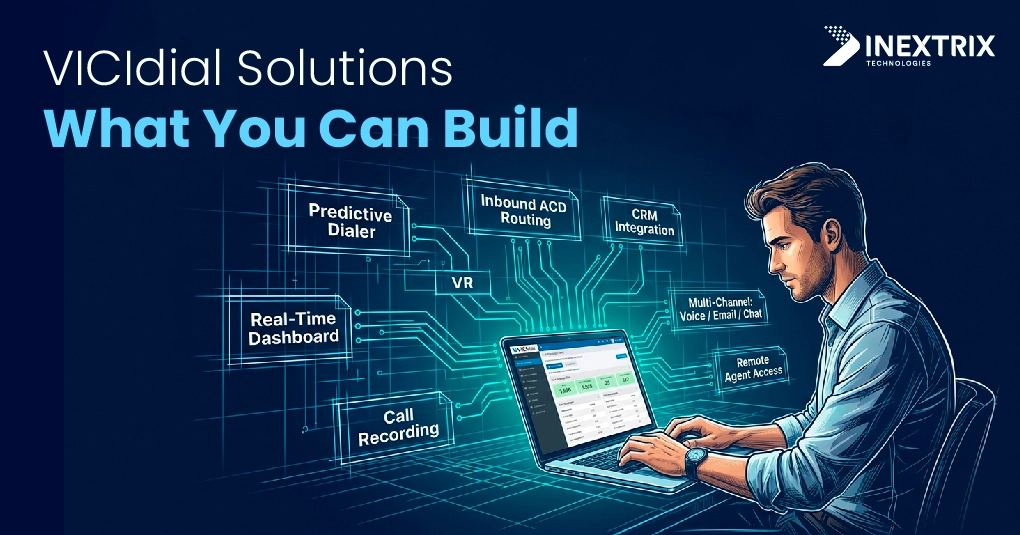
Custom VICIdial solutions go beyond basic calling features. The platform provides the core telephony system, while the real value comes from what is built on top of it to match specific business needs.
1. CRM and Business System Integration
- Real-time two-way sync with CRMs like Salesforce, HubSpot, Zoho, or custom systems
- Lead injection through REST APIs with duplicate checks and priority routing
- Automatic screen pop on inbound calls showing customer details for agents
- Post-call updates that sync dispositions to CRM without manual entry
2. Advanced Reporting and Analytics
Standard VICIdial reports only show basic summaries. Custom reporting provides deeper insights such as agent-wise conversion rates by campaign, real-time queue status, hourly call trends, and automatic alerts when SLAs are at risk.
3. IVR and Routing Customization
- Multi-level IVR with time-based and skill-based call routing
- Overflow routing to other agent groups or external trunks
- Callback scheduling in IVR to reduce hold times
- Dynamic prompts that display customer data when the call starts
4. Compliance and Recording Infrastructure
- Call recording per campaign with retention rules and automatic archiving
- TCPA-compliant dialing with time-zone filters and scrub list management
- Encrypted storage for recordings with role-based access control
- Automatic audit logs for compliance and reporting requirements
Performance Optimization: Making VICIdial Production-Ready
A working VICIdial system is not the same as a high-performing one. Optimization is an ongoing process, not just a one-time setup during launch.
Predictive Dialer Tuning
VICIdial’s predictive dialer adjusts call volume based on real-time agent availability. To work correctly, it must be tuned for dial ratios, answering machine detection accuracy (typically 92–96%), and acceptable abandonment rates. If configured poorly, it can reduce efficiency or create compliance risks.
Asterisk Tuning for High Concurrency
- DAHDI setup for hardware or virtual timing sources
- Choosing between chan_sip and PJSIP based on trunk setup and scale needs
- Adjusting memory and file descriptor limits to support high concurrent calls
- Using real-time configuration to avoid disruptions during dialplan updates
Linux OS and Network Layer Configuration
VoIP performance starts at the operating system level. VICIdial production servers require network buffer tuning, proper CPU performance settings, and optimized network handling for traffic. Firewall rules must also be configured carefully to avoid adding delay to RTP voice streams.
Why Open-Source Call Center Development Demands Expert Engineering
Open-source call center systems are not a shortcut; they shift responsibility from licensing to technical ownership. Instead of paying for a fully managed platform, teams must design, maintain, and scale the system themselves in call center development environments.
Most organizations also end up with multiple disconnected tools instead of one unified system, which leads to complexity and inefficiency.
With VICIdial, common issues include:
- Running outdated VICIdial versions, leading to security and maintenance risks
- Using external tools like FreePBX for outbound campaigns instead of native VICIdial features
- Poor scaling decisions without proper clustering, causing failures under high call volume
This is why expert VICIdial development services are important. The real value is not just writing code, but understanding what fails, when it fails, and how to design systems that stay stable under real-world call center pressure in call center development projects.
Also Read: How Custom VoIP Development Unlocks Real Business Growth
How Inextrix Approaches VICIdial Development
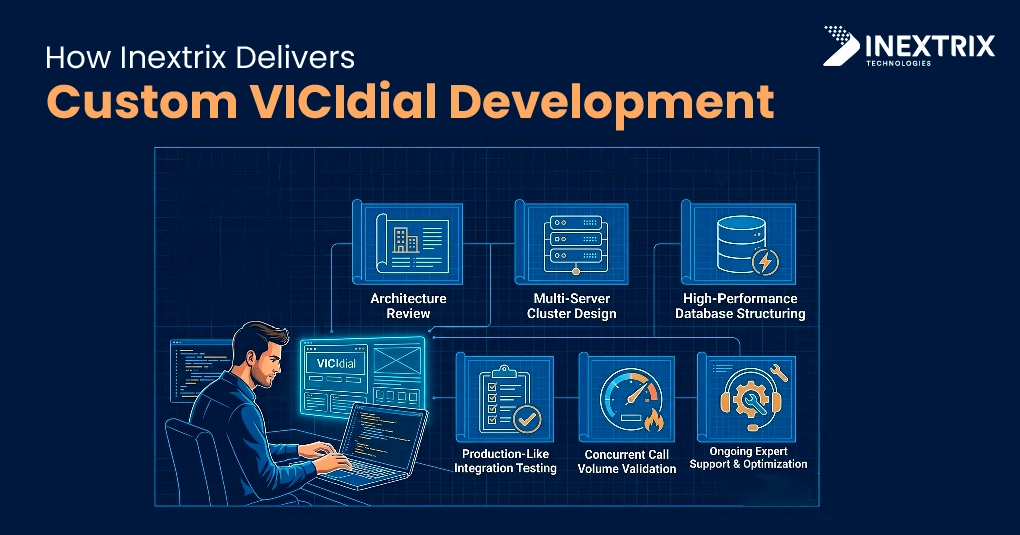
Inextrix is a telecom technology company with experience in VICIdial, FreeSWITCH, OpenSIPS, and custom VoIP platform development . Our focus is on building stable, scalable, and production-ready call center systems.
What this means in practice:
- Reviewing system architecture before development starts to avoid future scaling issues
- Designing multi-server clusters based on real call volume requirements
- Building database structures that can handle heavy call center traffic from the beginning
- Testing integrations using production-like traffic instead of basic sandbox testing
- Validating system performance at expected concurrent call volumes before deployment
- Providing ongoing support from experts who understand both the setup and the underlying system behaviour
The contact center as a service market is growing rapidly, with projections increasing from USD 8.33 billion in 2026 to USD 30.15 billion by 2034. Companies building call center platforms need infrastructure that can scale with business growth instead of requiring major rebuilds every time demand increases.
Use Cases: Who Benefits from a Custom VICIdial Solution
1. BPOs and Outbound Campaign Operations
Large outbound call centers need scalable predictive dialing, accurate answering machine detection, and lead management that can handle high call volumes efficiently. Custom VICIdial solutions provide these capabilities while reducing per-agent costs compared to many commercial platforms.
2. VoIP Service Providers Building White-Label Platforms
VoIP service providers and ITSPs offering hosted call center services need platforms that support custom branding, tenant separation, and independent scaling. A multi-tenant custom VICIdial setup is well suited for this type of deployment.
3. Telecom Startups Launching Niche Contact Center Products
Startups in industries like debt collection, insurance, or real estate need call center platforms built around their specific workflows. VICIdial’s flexible architecture allows custom features and industry-specific configurations without high enterprise software costs.
4. Enterprises Replacing Legacy Call Center Infrastructure
Enterprises using outdated call center software often face high renewal costs and limited flexibility. A properly planned VICIdial migration provides a modern, customizable platform without recurring per-agent licensing fees.
Conclusion
VICIdial is a powerful call center platform used by thousands of businesses worldwide. The latest versions support modern technologies like PHP, Asterisk 18, and WebRTC, making it capable of handling large-scale production environments when configured properly.
Building a scalable VICIdial solution involves more than basic setup. It requires proper system architecture, database planning, clustering, performance optimization, and integration development to ensure stable operation under heavy workloads.
Companies that treat VICIdial as just a simple configuration project often face scaling and reliability issues later. Those that approach it with proper planning and technical expertise build platforms that can grow with their business.