

Many companies rush into VoIP deployment without a strong technical strategy. As a result, they often face dropped calls, latency issues, scalability bottlenecks, and systems that fail under heavy traffic. These are not isolated incidents they occur when custom VoIP software development is treated as a simple setup task rather than a complex engineering initiative.
The global VoIP market is growing fast, expected to rise from $144.77 billion in 2024 to $326.27 billion by 2032 at a CAGR of 10.8%. But many companies still struggle that rush into VoIP deployment without a strong technical planning.
This guide explains the most common VoIP deployment challenges, what causes them, and how experienced telecom developers solve them. If you are building, scaling, or stabilizing a VoIP platform, this is the operational reality you need to understand.
6 Most Common VoIP Deployment Challenges
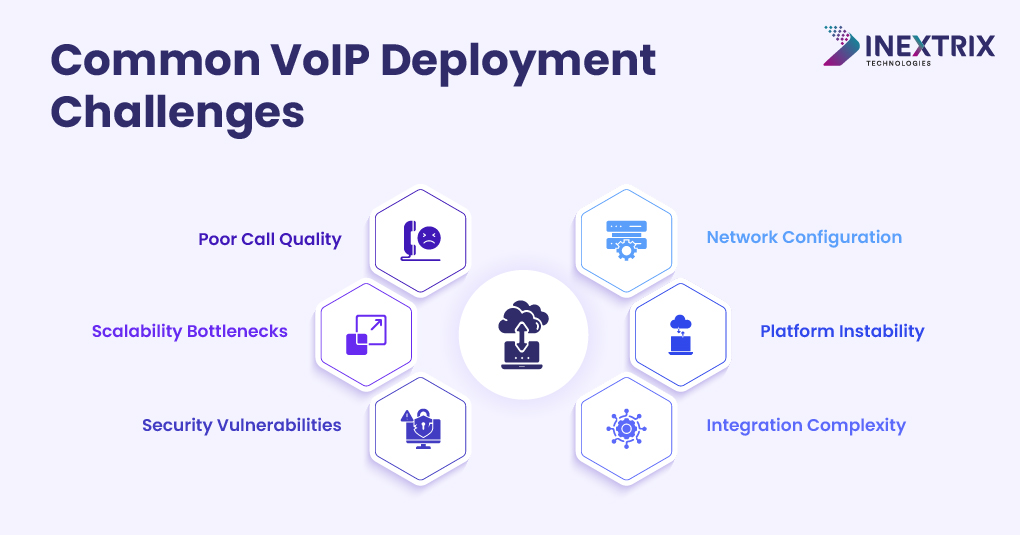
1. Poor Call Quality: Latency, Jitter, and Packet Loss
Poor call quality is one of the most common VoIP issues. In most cases, VoIP platform troubleshooting starts here because users quickly notice delays, broken audio, or dropped words. Voice traffic is far more sensitive to network problems than regular data traffic.
What the Numbers Say
According to ITU-T G.114 recommendations, one-way latency above 150 ms degrades call quality noticeably. Packet loss above 1% causes audible errors with G.711 codecs, and loss above 5% makes calls nearly unusable. Jitter should stay below 30 ms for stable audio.
Common Root Causes
- Latency: Physical distance between endpoints, excessive network hops, and unoptimized routing all push round-trip times above the 150 ms threshold.
- Jitter: Inconsistent packet arrival times caused by congested links or poorly configured QoS policies produce choppy, fragmented audio.
- Packet loss: Hardware failures, bandwidth saturation, and misconfigured switches drop packets before they reach their destination.
- Codec mismatches: Using high-compression codecs like G.729 on links that can support G.711 introduces unnecessary quality degradation.
VoIP Development Solutions
- VoIP performance optimization through proper QoS configuration that marks and prioritizes voice traffic above data.
- RTP stream optimization and jitter buffer tuning matched to actual network conditions.
- Network path analysis to reduce hop counts and eliminate routing inefficiencies.
- Active monitoring with MOS scoring to catch degradation before users report it.
This is the type of work handled during VoIP development projects, where developers start with diagnostics before changing configurations.
2. Scalability Bottlenecks That Break Platforms
As VoIP traffic grows, many platforms begin to struggle under higher call volumes. A system that works well at 500 concurrent calls may become unstable at 1,000 calls if the architecture is not built to scale properly. Scaling a VoIP platform is not just about adding more hardware. It requires proper system design and infrastructure planning.
Common Scalability Problems
- Single-server FreeSWITCH deployments quickly hit CPU and memory limits.
- OpenSIPS proxies built for small setups struggle with heavy SIP registration traffic.
- MySQL and PostgreSQL databases become overloaded when CDR processing is not optimized.
- Poor load balancing causes some servers to handle more traffic than others
Architecture-Level Fixes
- VoIP scalability solutions using FreeSWITCH clustering to distribute call traffic across multiple servers.
- OpenSIPS dispatcher configuration for better load balancing and failover support.
- Horizontal scaling to increase capacity without interrupting active calls.
- Asynchronous CDR processing to reduce database load during call handling.
For businesses facing these issues, voip consulting focused on capacity planning can prevent major platform failures before they happen.
3. Security Vulnerabilities in VoIP Infrastructure
Security is one of the biggest VoIP deployment challenges. 46% of illegal calls involve VoIP technology, and DDoS attacks targeting VoIP infrastructure in Q2 2025 were 44% higher than the same period in 2024. VoIP systems are frequent targets for fraud, account hijacking, and DDoS attacks. A single security breach can lead to major financial losses within hours.
Common VoIP Security Threats
- SIP registration flooding overwhelms SIP registrars with fake requests.
- Toll fraud uses compromised accounts to make expensive international calls.
- RTP injection allows attackers to intercept or disrupt audio streams.
- VoIP denial-of-service attacks overload SIP systems and crash platforms.
Security Hardening Solutions
- SIP rate limiting and registration throttling in OpenSIPS.
- TLS for SIP signaling and SRTP for encrypted voice traffic.
- Fail2ban integration for automatic IP blocking after failed login attempts.
- IP whitelisting for trusted carriers and continuous VoIP system stability monitoring to detect unusual traffic patterns early.
Many businesses still lack strong cybersecurity protection for VoIP systems. That is why security must be built into the platform architecture from the beginning, not added later after problems appear.
4. Network Configuration and Interoperability Issues
Most VoIP environments use equipment from multiple vendors. Carriers, gateways, phones, and media servers all need to work together smoothly, but differences in configuration often create serious compatibility issues.
Common Configuration Problems
- VoIP deployment issues often begin with NAT traversal problems, where calls connect but audio is missing or only works one way.
- Codec negotiation failures happen when devices cannot agree on the same codec.
- SIP header compatibility issues occur when carriers require specific header formats that platforms do not handle correctly.
- DTMF relay mismatches can break IVR systems and keypad input functions.
Resolution Approach
- Deploy STUN/TURN servers with proper external IP configuration for NAT traversal.
- Use SIP trace analysis tools like sngrep or Homer to inspect signaling traffic.
- Configure header manipulation rules in OpenSIPS for non-standard carrier requirements.
- Perform VoIP platform troubleshooting at the protocol level to identify codec, NAT, and SIP signaling issues that basic monitoring tools often miss.
5. System Crashes and Platform Instability
VoIP platform crashes during high traffic are usually caused by weak system architecture. As cloud-based contact center usage continues to grow, platforms that are not built for high availability struggle to stay stable under heavy load.
Common Causes of Platform Crashes
- Memory leaks in long-running FreeSWITCH servers can eventually cause system crashes.
- Malformed SIP messages or unusual SIP traffic can break SIP parsers and crash services.
- Database connection pool exhaustion can block call processing and create system-wide instability.
- Missing watchdog systems allow failed processes to remain offline instead of restarting automatically.
Building Stable Infrastructure
- VoIP system stability depends on active/passive failover setups with heartbeat monitoring between servers.
- Process supervision using systemd or watchdog scripts helps restart failed services automatically.
- Load testing before deployment identifies system limits under real traffic conditions.
- Structured logging and monitoring with tools like Grafana help teams detect problems before users are affected.
6. Integration Complexity: WebRTC, APIs, and Legacy Systems
Modern VoIP platforms do not work alone. They connect with CRMs, call center software, billing systems, and WebRTC applications. Every integration adds new points where problems can occur, making integration issues a common challenge for VoIP development teams.
Common Integration Challenges
- WebRTC-to-SIP bridging issues caused by ICE negotiation failures, DTLS handshake timeouts, and codec mismatches between browser clients and SIP systems.
- REST API rate limits from carrier providers that create call delays or failed connections.
- Legacy PBX integration problems when older systems do not support modern SIP authentication methods.
- Billing system CDR synchronization failures that can lead to revenue loss on high-volume platforms.
Engineering Approach
- Media gateway design for stable WebRTC-to-SIP translation with proper TURN server setup.
- Custom VoIP software development for integration layers that manage retries, error logging, and failover when APIs become unavailable.
- Legacy system modernization using SIP normalization layers instead of complete infrastructure replacement.
How Inextrix Solves VoIP Deployment Challenges

Most VoIP issues are easier to solve with developers who have real telecom experience. Inextrix works as a telecom consulting services and VoIP development partner for businesses building and scaling VoIP infrastructure.
What We Bring to Deployments
- Deep expertise in FreeSWITCH and OpenSIPS: both platforms, real production environments, not documentation-level familiarity. If you need to hire VoIP developer resources with genuine hands-on experience, that is what our team is.
- VoIP scalability solutions for everything from single-server systems to large multi-region platforms handling thousands of concurrent calls
- VoIP performance optimization including QoS setup, codec tuning, RTP optimization, and network analysis
- Platform stabilization through crash troubleshooting, high-availability architecture, and advanced monitoring setup
- Security hardening with SIP-aware firewalls, toll fraud prevention, encryption, and voice traffic anomaly detection.
Our Engagement Model
We work as dedicated telecom engineers embedded in your development or operations team, or as a consulting partner for specific projects. Both models are structured around solving your actual VoIP deployment challenges, not selling hours.
Conclusion:
The VoIP deployment challenges discussed in this guide are common across the telecom industry, from small ITSPs to large CPaaS providers. As the business VoIP market continues to grow, companies need platforms built on strong engineering and stable infrastructure.
Whether the issue is call quality, scalability, security, or platform instability, the first step is understanding the real infrastructure problem behind it. This is where telecom consulting services and experienced VoIP development teams provide the expertise needed to diagnose and solve complex VoIP issues.
If your platform is facing any of these challenges, working with experts in custom VoIP software development and telecom infrastructure can help you build a more stable, scalable, and secure system.